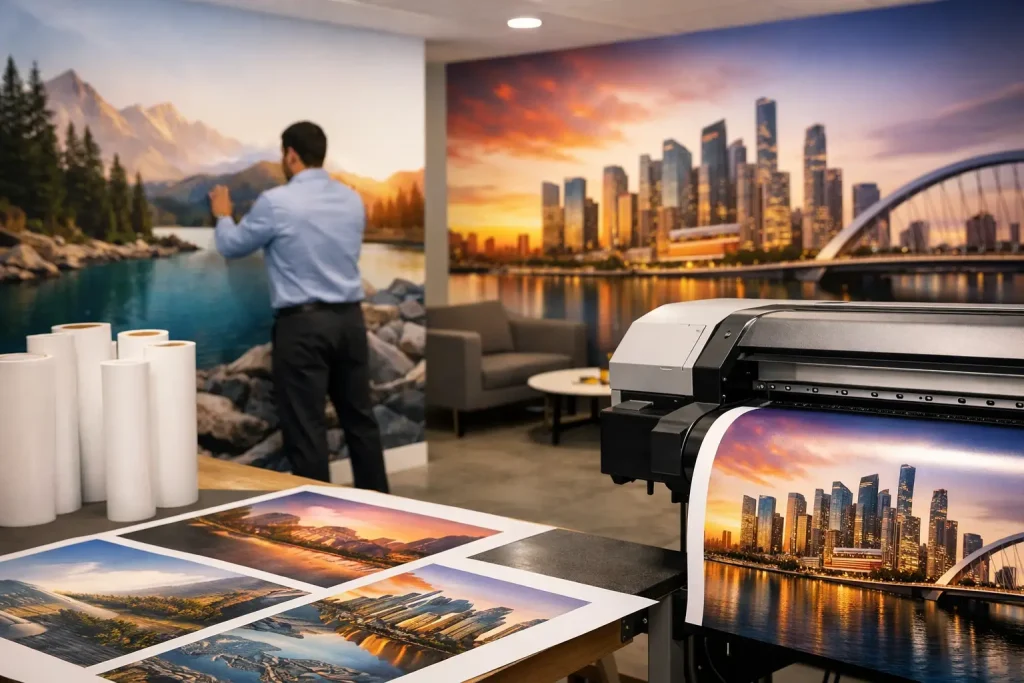
A blank wall rarely stays neutral in a business setting. In a retail store, it becomes missed branding space. In an office, it can feel unfinished. At an event, it can make the booth look underbuilt. Wall mural sticker printing solves that problem with a format that turns plain surfaces into branded environments quickly, cleanly, and at scale.
For businesses, this is not just a decorative product. It is a practical branding tool used to support customer experience, reinforce brand identity, promote campaigns, guide foot traffic, and improve the look of commercial interiors without the time and cost of permanent construction. The value is simple – large visual impact, faster deployment, and more flexibility than paint, framed graphics, or built-up wall features.
What wall mural sticker printing is used for
Wall mural stickers are large-format printed graphics produced on adhesive material and applied directly to walls or other flat surfaces. In commercial use, they are typically custom sized and designed around the space rather than ordered as a one-size-fits-all product.
This matters because business walls serve different functions. A café may want an Instagram-friendly feature wall. A corporate office may need mission statements, brand values, or culture graphics in meeting rooms and reception areas. A retailer may use seasonal promotional visuals to refresh the space without a full renovation. Exhibition teams often use mural-style wall graphics to turn shell scheme panels or backdrop walls into branded displays.
The core advantage is coverage. A mural does what smaller signage cannot. It changes how the whole space feels, not just what one sign says.
Why businesses choose wall mural sticker printing
The biggest reason is speed. Compared with repainting, fabricating wall panels, or commissioning custom fixtures, wall mural sticker printing is usually faster to produce and install. That makes it useful for campaign launches, retail refreshes, office openings, pop-ups, and event deadlines.
There is also more design freedom. A mural can carry photography, illustration, typography, patterns, product visuals, directional messaging, or brand storytelling across an entire wall. If the file is prepared correctly, the output can be scaled to fit a lobby wall, a corridor, a showroom, or a temporary event space.
Cost control is another factor. It depends on wall condition, size, material choice, finishing, and installation requirements, but wall graphics often deliver a stronger visual result per square foot than many rigid display alternatives. For buyers managing multiple branded touchpoints, that efficiency matters.
Flexibility is the trade-off that makes this format especially attractive. Some wall graphics are meant to stay up long term. Others are installed for a campaign period and removed later. That choice affects material selection, adhesive strength, print finish, and wall preparation.
Where wall mural sticker printing works best
Commercial interiors benefit the most when the mural is tied to a business goal rather than added just to fill space. Reception walls work well because they create a strong first impression for clients, visitors, and staff. Retail walls support product storytelling and seasonal promotion. Restaurants and cafés use murals to shape atmosphere while keeping branding visible without adding clutter.
Office environments often use wall graphics more strategically than people expect. Teams install them in training rooms, collaboration areas, hallways, and pantries to support culture messaging, internal communication, and branded consistency across departments. In larger workplaces, murals can also help with zoning and navigation.
Events and exhibitions are another strong fit. A mural-style wall graphic can turn standard panels into a fully branded backdrop, making the booth look more complete without heavy fabrication. This is especially useful when setup time is tight and transport needs to stay manageable.
Not every wall is a good candidate, though. Rough, dusty, damp, or freshly painted surfaces can cause adhesion problems. Highly textured walls may need different materials or an alternate display method altogether. This is where site checking and production guidance make a real difference.
Choosing the right material for wall mural sticker printing
Material selection should be based on surface condition, expected lifespan, and removal needs. That is where many projects either run smoothly or run into avoidable issues.
For smooth painted walls indoors, standard adhesive vinyl may be suitable for many applications. It offers good print quality and works well for branding graphics, promotional messaging, and interior feature walls. If the wall has a more delicate finish or the graphic is meant to be temporary, a removable adhesive option may make more sense.
Textured wall materials exist for surfaces that are less than ideal, but they are not a universal fix. Deep texture, unstable paint, or poor wall prep can still affect performance. If the wall is a high-touch area such as a corridor corner, behind seating, or next to a queue line, durability becomes even more important.
Finish also matters. Matte finishes reduce glare and usually work better for office lighting and photography-heavy designs. Gloss may boost color punch, but it can reflect overhead lights and make some spaces look harsher than intended. Lamination may be added when extra protection is needed, especially in retail, F&B, or public-facing environments.
Design considerations that affect the final result
Large-format graphics magnify both strengths and mistakes. A mural that looks good on a laptop screen can fail on the wall if the artwork is not built for scale.
Resolution is the first checkpoint. Pixelated images become obvious when stretched across a full wall. Text placement is another common issue. Important messaging should not land behind furniture, along wall joins, or too close to the ceiling line. The wall may seem like one visual plane in a mockup, but the actual space includes switches, sockets, glass panels, corners, trims, and obstacles that affect layout.
Color should also be approached realistically. Printed output interacts with ambient lighting, wall tone, and room materials. A dark brand palette may look elegant in concept but heavy in a narrow hallway. A highly detailed image may lose impact when viewed from a distance. Strong mural design is not just about making artwork bigger. It is about adapting the creative to how the wall will actually be used.
For brand-led environments, consistency matters. If the mural is part of a larger office fit-out, retail rollout, or event setup, it should align with other printed elements such as foam boards, standees, directional signs, window stickers, and promotional panels.
Installation is part of the product
A wall mural is only as good as its installation. Even a strong print file and suitable material can look poor if the panels are misaligned, bubbled, stretched, or installed on a wall that was not prepared properly.
This is why commercial buyers should treat installation as part of the production scope, not an afterthought. Larger murals often require paneling, careful positioning, trimming around fixtures, and on-site judgment based on wall condition. Timelines also need to account for access hours, lift requirements, and coordination with fit-out or event teams.
In active business environments, scheduling matters as much as print quality. A retail install may need to happen after trading hours. An office wall graphic may need to be completed before a launch or internal event. Exhibition graphics may have narrow venue access windows. Working with a print partner that handles production and execution reduces delays and responsibility gaps.
Getting better results from a mural project
The most efficient projects start with practical information: wall dimensions, clear photos of the site, intended use, expected duration, and any restrictions around access or installation timing. That allows accurate recommendations on material, finishing, and panel layout.
It also helps to decide early whether the mural is brand-led, campaign-led, or decorative. Those are not the same brief. A permanent office branding wall may prioritize durability and clean typography. A short-term retail campaign may prioritize speed and removability. An event backdrop may prioritize visual impact from a distance.
For businesses managing multiple outputs at once, it is more efficient to source mural graphics alongside other branded materials rather than treating them as a standalone order. That keeps color direction, production timing, and site coordination more consistent. For project-based buyers in Singapore, that kind of consolidated execution is often the difference between a smooth launch and a last-minute scramble.
Wall mural sticker printing works best when it is planned as part of the space, not added at the end. If the wall has a job to do, the print should do it clearly, cleanly, and on schedule.