
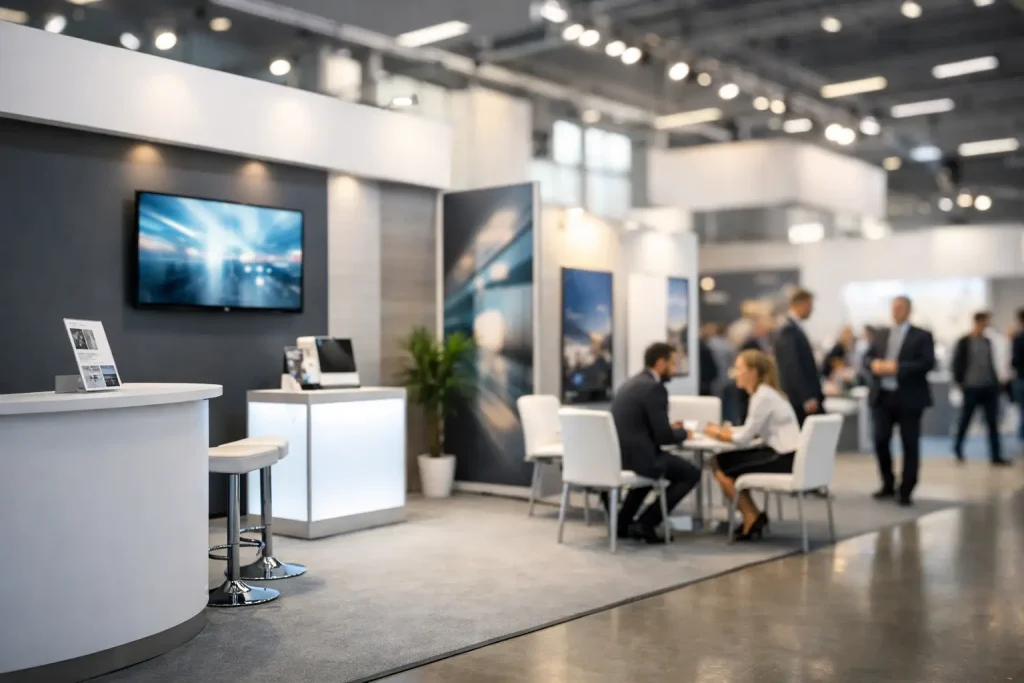
A crowded expo floor exposes weak branding fast. If your booth message takes more than a few seconds to read, if your graphics look stretched, or if your setup feels improvised, people keep walking. This trade show display guide is built for teams that need more than a good-looking booth. It is for buyers who need display systems, printed graphics, signage, counters, backdrops, and setup choices that support actual event results.
What a trade show display guide should help you decide
Most event teams do not need more options. They need clearer decisions. The right display is not just a backdrop with a logo on it. It is a working environment for product conversations, lead capture, demos, samples, storage, and brand visibility.
That means the first question is not which display looks best. The first question is what the booth needs to do. A launch booth usually needs impact from a distance and strong product storytelling. A lead-generation booth may need a more open front, faster messaging, and room for staff movement. A distributor or B2B meeting booth often needs cleaner presentation, seated discussion space, and printed materials that support follow-up.
When those goals are clear, the display format becomes easier to choose.
Start with booth size, traffic flow, and viewing distance
A display that works in a 10×10 booth may fail in a larger footprint. Booth size affects more than dimensions. It changes how visitors approach, where they stop, and how much messaging they can absorb.
In a smaller booth, every surface matters. A back wall, one branded counter, and a single focused message often perform better than trying to show every product category at once. In a larger booth, you have room for layered communication. A high backdrop can pull attention from afar, while closer signage can handle product details, pricing, or technical information.
Viewing distance matters just as much. Large logos and short headlines carry from the aisle. Detailed charts, QR codes, and product specs only work when placed where people can stop and read them. Many booths fail because everything is designed at the same scale. Good display planning uses distance on purpose.
The core display formats and when they make sense
Pop-up backdrops and fabric walls
These are common because they solve a practical problem quickly. They are portable, relatively fast to install, and effective for brand visibility. For companies doing frequent events, they offer a repeatable setup without heavy fabrication.
The trade-off is that simple systems can look generic if the graphic design is weak. A clean, high-resolution print with disciplined messaging helps. If the event is highly competitive or premium-positioned, you may need additional elements so the booth does not look flat.
Modular booth systems
Modular displays work well when you need flexibility across multiple event sizes. The same system can often be reconfigured for different booth footprints, which helps control cost over time.
This is a strong option for businesses that exhibit regularly and want a more structured, built-out presence without committing to a fully custom booth every time. The main consideration is planning. Modular only saves time and money when the graphic panels, counters, shelving, and accessories are designed as a system from the start.
Custom exhibition booths
Custom booths make sense when the event matters enough to justify a more tailored environment. If you need branded zones, integrated product displays, carpentry, storage, private meeting space, or a stronger architectural look, standard systems may not be enough.
They also come with more production coordination. Materials, transport, setup scheduling, and on-site installation all need tighter control. For major launches or flagship industry events, that added effort can be worth it. For smaller shows, it may be more than you need.
Counters, kiosks, and demo stations
These are not secondary pieces. They shape how people interact with the booth. A branded counter can handle welcome conversations, brochure placement, samples, and lead forms. A demo station gives product presentations a dedicated area instead of forcing staff to improvise in the aisle.
The right counter height, print finish, and storage access matter more than many teams expect. If staff cannot move efficiently or hide basic booth supplies, the whole setup feels less professional.
A practical trade show display guide to graphics that work
Booth graphics usually fail in one of two ways. Either they say too much, or they say too little. A wall full of small text gets ignored. A booth with only a logo may look polished but does not help a visitor understand what you offer.
A better approach is to organize graphics in layers. The first layer is distance messaging – your brand name, category, and one clear value statement. The second layer is the closer view – product groups, service capabilities, or a featured solution. The third layer is support material – brochures, mounted boards, tabletop displays, or printed handouts for people already in conversation.
Print quality matters here. Fuzzy logos, poor color consistency, visible panel joins, and reflective glare weaken credibility immediately. This is especially true under trade show lighting, where defects become more obvious. High-resolution production, correct material choice, and proper finishing are not cosmetic upgrades. They are part of how the brand is judged on the floor.
Materials, durability, and installation details
Not every display material fits every event. Foam board panels can be useful for lightweight presentation graphics, but they are not always the best choice for repeated shipping and reuse. Fabric graphics can pack efficiently and look clean, but only when color output and tension are controlled properly. PVC and rigid board applications can create stronger visual structure, especially for counters, freestanding signs, or branded display elements.
This is where event frequency matters. If you exhibit once a year, a lower-cost solution may be enough. If your team travels from show to show, durability and replacement planning become more important. Hardware reliability, reprint turnaround, and install support affect total cost more than the initial quote alone.
Installation is another common weak point. A good display can still underperform if setup is rushed or technical requirements are overlooked. Ceiling height, venue access, electrical planning, storage needs, and dismantling schedules should be considered before production is finalized.
Do not treat signage as an afterthought
A booth display gets the attention, but supporting signage does a lot of the selling. Freestanding signages, product boards, price displays, tabletop graphics, shelf talkers, and directional pieces help move visitors through the space.
This matters even more when you offer multiple services or product lines. Instead of forcing one backdrop to explain everything, supporting signs can segment information clearly. One board can explain a product category. Another can show application examples. Another can support promotions, bundles, or event-specific offers.
For food, retail, franchise, and multi-location businesses, this structured signage approach often performs better than one oversized visual trying to carry the whole message.
Plan the print package, not just the booth wall
Trade show performance depends on how all printed pieces work together. The booth wall is only one part of the package. Your team may also need brochures, flyers, product catalogs, business cards, sticker labels, branded apparel, packaging samples, and takeaway folders.
When these items are designed and produced separately, the result often feels disconnected. Colors shift. messaging changes. logos are scaled inconsistently. A more controlled approach is to build the event package as one branded system.
That system can include the large-format display, counters, mounted boards, handouts, name cards, uniforms, and even supporting promotional items. For buyers managing event deadlines, sourcing those categories through one production partner can reduce revision cycles and simplify approvals.
Common mistakes that waste booth spend
The most expensive booth mistake is usually not overspending. It is spending on the wrong thing. A large display does not guarantee traffic if the message is vague. Premium materials do not help if the layout blocks entry. A beautiful backdrop does little if your printed collateral is missing, outdated, or inconsistent.
Another mistake is designing from a screen instead of from the aisle. Booth artwork needs to be judged at actual scale. What looks balanced in a digital proof may become unreadable once installed. Likewise, trying to reuse old graphics across new hardware can create fit, alignment, and finish problems that are obvious in person.
Finally, do not ignore operations. If your team has nowhere to place bags, literature, personal items, or extra stock, clutter appears within an hour. Storage, access, and reset time are part of booth design.
Choosing a display partner
A display vendor should do more than print files. They should help identify the right format, flag production risks, recommend materials based on use, and support the setup requirements of the event. That becomes more valuable when your project includes exhibition materials, counters, rigid signs, apparel, or installation work alongside the main display.
For teams exhibiting in Singapore, a partner like Pisti Prints can be useful when the requirement goes beyond one backdrop and into coordinated booth graphics, signage, fabrication, and on-site execution. That kind of support is especially practical when event timelines are tight and multiple printed assets need to land together.
The best display is not always the biggest or most custom. It is the one built around your booth goal, printed to hold up under event conditions, and organized to help your team work the floor well. If you approach your next event that way, the booth will not just look better. It will be easier to use, easier to manage, and more likely to earn its space.