A busy exhibition floor gives a brand only a few seconds to earn a stop. A wall of product facts, a generic pop-up banner, or a booth that looks like every other booth will not do the job. The future of exhibition booth design is moving toward spaces that are easier to adapt, faster to install, more useful for sales conversations, and more responsible to reuse after the event.
For marketing teams and event organizers, this is not simply a design trend. It changes how booths are planned, budgeted, produced, transported, and measured. The most effective stands will still need strong graphics and solid construction. They will also need a clear visitor journey and a practical plan for what happens after the show closes.
The future of exhibition booth design starts with flexible systems
Custom-built booths remain valuable when a launch, flagship event, or major product demonstration needs a strong physical statement. But building a completely new structure for every show can create unnecessary cost, storage issues, and material waste. That is why modular booth systems are becoming the practical default for many exhibitors.
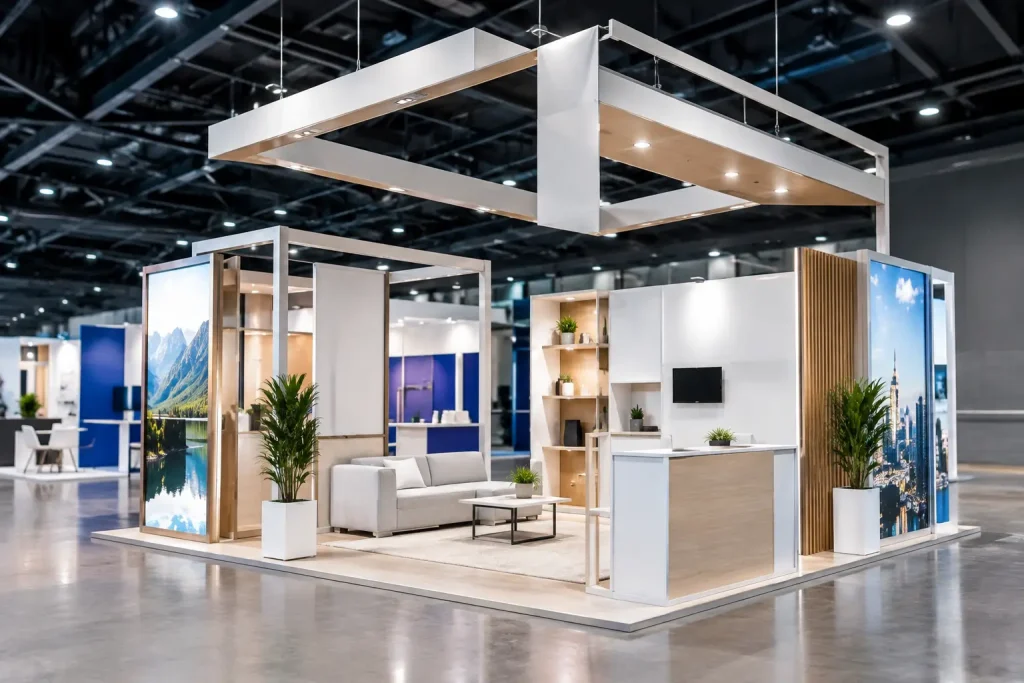
A modular structure can be resized for different footprints, reconfigured around new product lines, and refreshed with replacement graphics. The same framework may support an inline booth at one event, a corner configuration at another, and a larger meeting-focused layout at a third. This gives teams a more predictable base cost while preserving room for new creative direction.
Flexibility does not mean every booth should look temporary. Well-planned modular displays can include fabric walls, rigid graphic panels, shelving, counters, overhead identifiers, display plinths, and integrated lighting. The key is to separate the reusable structural components from the campaign-specific visual elements.
Design for more than one floor plan
Before fabrication begins, exhibitors should identify the booth sizes they are likely to book across the year. A layout designed only for one large island space may be difficult to reuse in a smaller row booth. Planning for common sizes helps a supplier recommend a system that can grow or contract without compromising the visual hierarchy.
This approach involves a trade-off. A fully bespoke timber build can deliver more sculptural freedom, while a modular system offers better repeat use and faster setup. The right choice depends on show frequency, audience expectations, budget, and whether the booth must include special features such as enclosed meeting rooms, product demo zones, or heavy retail displays.
Better graphics will carry more of the booth’s impact
As booth structures become more reusable, printed surfaces become the fastest way to make each event feel new. Large-format graphics, wall murals, backlit fabric displays, floor decals, hanging signs, and branded counters turn a standard frame into a specific campaign environment.
The future of exhibition booth design is not about filling every surface with messages. It is about making the message readable from the aisle, understandable at the booth edge, and persuasive during a closer conversation. Visitors should be able to identify the brand, the main offer, and the reason to stop before they reach the stand.
A strong booth graphic plan usually works in layers. The highest-level message should be visible at distance. Product categories or core benefits can appear at mid-range. Detailed specifications, case studies, QR codes, and sales materials belong where a visitor has chosen to engage. This prevents the common problem of a booth that looks crowded from ten feet away.
Color accuracy, material selection, and finishing also matter. Fabric graphics create a refined, low-glare appearance and pack efficiently. Foam board, PVC panels, and acrylic elements can add rigidity and dimension. Backlit graphics can improve visibility in a crowded hall, but they require correct power planning and should support the message rather than become a distraction.
Technology should support the sales conversation
Interactive screens, touch displays, product configurators, lead capture tools, and digital catalogs will continue to appear in exhibition spaces. Used well, they help staff explain complex products without covering every wall in text. Used poorly, they create queues, technical failures, and visitors who look at a screen instead of speaking with the team.
The most useful technology has a clear operational purpose. A screen might show product use cases that are difficult to demonstrate physically. A tablet can collect qualified leads and route them to the correct sales team. A short display loop can explain a service while staff members handle conversations. These applications make the booth more productive without turning it into a gadget display.
Technology also needs a backup plan. Internet access can be inconsistent, devices need charging, and files must be tested before installation. Critical messages should never live only on a screen. Printed graphics, brochures, product cards, and signage still provide reliable information when a device fails or the booth is busy.
Create clear zones instead of one open display
Future-focused booths will be designed around visitor behavior. An open front area encourages entry. A visible product or demo zone gives people a reason to pause. A counter or consultation table supports a more focused conversation. If the sales cycle is longer, a semi-private meeting area may be worth the floor space.
Not every exhibitor needs all of these zones. A food and beverage brand offering samples may prioritize traffic flow and product presentation. A B2B software provider may need more screens and meeting tables. An industrial supplier may require space for equipment, samples, and technical discussions. The layout should match the action the exhibitor wants visitors to take.
Sustainability will be judged by execution, not claims
Sustainability is becoming a practical requirement for exhibition buyers, venues, and procurement teams. But a booth is not sustainable because it uses a natural-looking finish or includes a recycling statement. The real question is whether materials can be reused, stored, repurposed, or responsibly handled after the event.
Reusable frames, replaceable graphic skins, durable counters, rental furniture, and compact packing methods can reduce the amount of material discarded between shows. Choosing the right material for the job also matters. A short-term graphic does not always require a heavyweight permanent panel, while a repeatedly used product display should be built to withstand transport and handling.
This is another area where planning delivers better results than last-minute changes. When the design team, print producer, fabricator, and installer coordinate early, they can specify components that fit the event schedule and the reuse plan. It also reduces the risk of paying for materials that cannot be practically stored or used again.
Speed and installation planning are part of the design
A striking concept that cannot be installed safely within venue hours is not a complete booth solution. Future exhibition projects will place more emphasis on build sequence, access requirements, electrical routing, loading restrictions, and on-site coordination.
For buyers, this means selecting a partner that understands both print production and physical execution. Large-format graphics need correct sizing and finishing. Signage needs suitable mounting. Carpentry elements need stable construction. Booth components must arrive labeled, protected, and ready for assembly. Installation teams need a clear layout, not a stack of unmarked panels and a last-minute sketch.
The earlier these details are confirmed, the more controlled the outcome will be. A quote should account for the full working scope: design support, printing, fabrication, packing, transport, installation, dismantling, and any storage or reuse requirements. The cheapest initial build is not always the most economical option across several events.
Plan the booth as a reusable sales asset
The strongest exhibition booths will increasingly function as a set of reusable brand assets. The same graphic language can extend to brochures, product sheets, staff apparel, retail displays, social media backdrops, packaging inserts, and follow-up materials. This creates a more consistent experience before, during, and after the event.
Pisti Prints supports this kind of coordinated execution by combining exhibition materials with large-format printing, signage, display fabrication, carpentry, and installation support. For exhibitors, working from one production plan can reduce mismatched colors, delayed components, and unnecessary handoffs between suppliers.
Start the next booth brief with three practical questions: What must visitors notice first? What must the sales team do inside the space? Which components should still be useful at the next event? Those answers will lead to a booth that works harder than a one-time backdrop.