
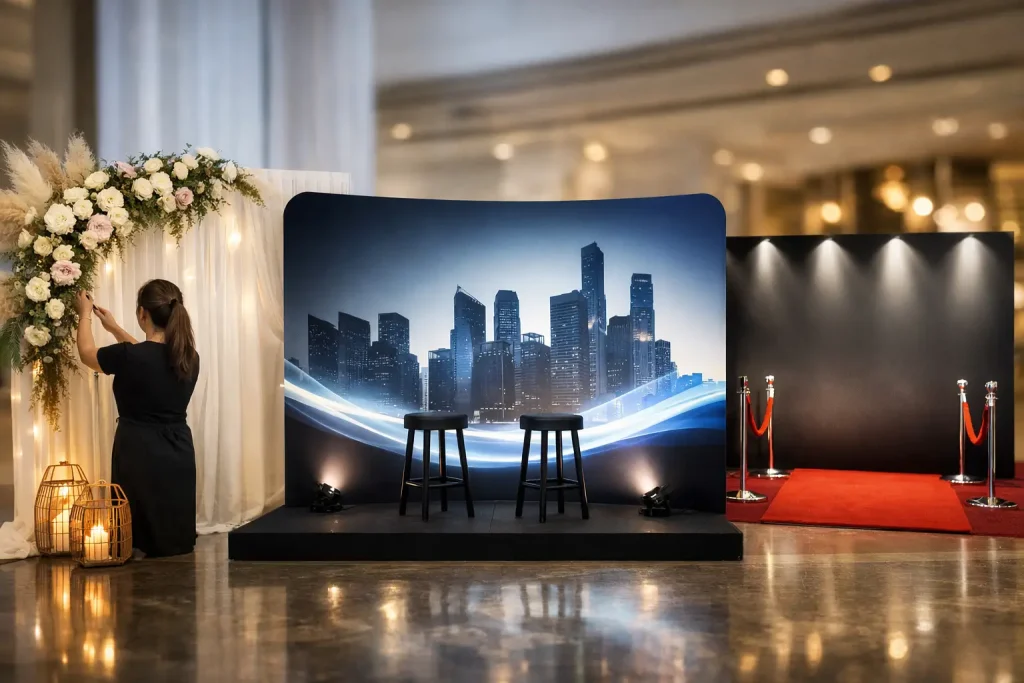
A stage backdrop that looks sharp in a mock-up can fail quickly on event day: the logo sits behind the speaker, the frame does not fit the ballroom ceiling, or the material reflects every spotlight. For an event backdrop Singapore businesses can rely on, the real work starts before production. The right choice depends on viewing distance, venue rules, photography needs, installation time, and whether the display will be used once or across several events.
For corporate launches, trade shows, media walls, award ceremonies, and retail activations, a backdrop is more than a decorative surface. It sets the visual boundary of the event, gives guests a clear photo moment, and puts your brand in every event image. Planning it as a production item, rather than a last-minute printed banner, avoids costly compromises.
Start With the Backdrop’s Job
The first question is not which material to print. It is what the backdrop must do. A sponsor wall behind a registration area has different requirements from a main stage backdrop. The sponsor wall needs repeated logos, good camera performance, and enough width for group photos. A stage piece needs clear hierarchy from a distance, allowance for screens and speakers, and a structure suited to the venue.
For a trade show, the backdrop may also need to define a booth, hold product messaging, and survive multiple days of visitor traffic. A retail activation may need a more finished appearance, with shaped panels, wall graphics, shelving, or carpentry elements integrated into the display.
Define the primary use early: presentation background, photo wall, exhibition wall, branded entrance, product launch display, or directional feature. This decision informs the dimensions, artwork, finish, and installation method.
Select a Format That Fits the Venue
There is no single best event backdrop format. Each option balances portability, finish, cost, and visual impact.
Fabric backdrops for a clean, camera-friendly finish
Printed fabric backdrops are a strong choice for media walls, corporate functions, and repeated use. The material produces a softer, less reflective surface than glossy vinyl and generally photographs well under event lighting. Fabric can be stretched over a frame for a neat, wrinkle-resistant presentation or supplied with finishing for installation on a venue structure.
The trade-off is that fabric requires careful handling, especially when it is intended to remain taut. It also needs an appropriately sized frame or mounting system. If the event team has limited setup time, confirm how the backdrop will be assembled, who will install it, and where the finished display will be stored after the event.
PVC banners for flexible, practical coverage
PVC banners remain a practical solution for large event graphics, outdoor use, temporary partitions, and straightforward stage applications. They are durable, cost-effective, and available in substantial sizes. Depending on the design, they can be finished with eyelets, pole pockets, hems, or other mounting options.
For indoor photography, avoid assuming that any PVC finish will perform the same way. Strong overhead lights or flash photography can create glare on a glossy surface. A matte finish is often the better direction for photo walls and branded backgrounds where people will stand close to the graphic.
Foam board and PVC panels for rigid displays
Rigid panels create a more structured, premium appearance. Foam board, PVC board, and other mounted substrates are suitable for freestanding features, directional panels, smaller photo moments, product displays, and layered stage elements. They can also be cut to shape for logos, lettering, or themed props.
These materials work well when the design needs depth. A printed base wall with raised logo panels, for example, gives a simple sponsor backdrop more presence without requiring a full custom build. The practical consideration is transport and installation. Large boards need protection from dents and may require joining, framing, or rear support.
Custom-built stage and exhibition backdrops
When an event calls for a stronger branded environment, a custom backdrop can combine printed graphics with framing, woodwork, light boxes, shelves, screens, or dimensional signage. This approach is often used for exhibition booths, product launches, retail pop-ups, and major corporate events.
A custom build offers the greatest flexibility, but it requires the earliest planning. Site measurements, venue load-in restrictions, electrical requirements, material approvals, and dismantling arrangements should be confirmed before fabrication begins. The result can be highly effective, but only when the design is buildable within the schedule and venue conditions.
Size It for People, Photos, and Sightlines
A backdrop that is technically large enough may still be visually weak. Size should be based on how many people will stand in front of it, where the audience sits, and how it appears through a camera lens.
For a small photo area, allow adequate width for two to four guests to stand comfortably without blocking the main logos. For a larger media wall, consider group shots, photographers stepping back, and traffic flow around the display. If guests will queue in front of the backdrop, leave clearance for entry and exit rather than placing it tight against a door or walkway.
Stage backdrops need even more coordination. Check the position of podiums, LED screens, floral arrangements, speakers, and presenters. Important branding should not sit too low, where it is hidden by furniture, or too high, where it disappears in wide event photographs. If a logo must appear behind a speaker, place it off-center or repeat it at a suitable scale across the artwork.
Ceiling height matters as much as wall width. A tall backdrop can look impressive, but only if the venue permits the frame height and has enough loading access. Request venue floor plans, photographs, and any technical guidelines before finalizing dimensions.
Build Artwork for Real Viewing Conditions
Backdrop artwork is not brochure artwork. Guests may see it from across a ballroom, while photographers may capture it from only a few feet away. The design must work at both distances.
Keep the main message brief. An event name, campaign line, sponsor logos, and one clear visual direction are usually enough. Small paragraphs, dense product specifications, and fine-line details do not translate well on a large-format display.
Use high-resolution source files and vector logos whenever possible. Enlarging a low-resolution web image often produces soft edges and visible pixelation in print. Brand colors should be supplied using established color references where available, but remember that printed output, event lighting, and digital screens will not always match perfectly. A proof or color discussion is especially useful for brand-critical campaigns.
For a photo wall, use enough contrast between the background and the logo so that the branding remains visible behind guests wearing light or dark clothing. Avoid placing a large logo exactly at face height. Repeating smaller logos in a controlled grid is often more effective than one oversized mark that disappears whenever a group poses for photographs.
Plan Installation Before Sending Files to Print
Installation details determine whether the finished backdrop looks intentional. A well-printed graphic can still sag, curl, lean, or show visible joins if the supporting method has not been planned.
Confirm the installation surface and access conditions. Is the backdrop mounted to an existing wall, supported by a freestanding frame, attached to a truss, or built as part of an exhibition booth? Can installers access the site early? Does the venue require approved contractors, safety documentation, or specific fire-rated materials? Are there lifts, loading bays, or time restrictions for delivery?
For outdoor events, wind load and weather exposure need special attention. A large solid banner can catch wind like a sail, so the frame, ballast, and material choice must be appropriate for the location. Indoor displays are usually simpler, but hotel ballrooms and mall spaces may have strict rules on wall fixing and floor protection.
Working with one production partner for printing, fabrication, delivery, and setup reduces handoffs between suppliers. Pisti Prints can support event teams with large-format print production, display materials, custom fabrication, and practical installation planning based on the project scope.
Order to the Event Timeline, Not the Print Timeline
A backdrop is rarely delayed because the printer cannot print it. Delays typically come from late logo approvals, missing venue details, revised dimensions, and artwork that needs rebuilding. Build time into the schedule for design checks, material selection, fabrication, and installation coordination.
Provide the event date, venue, intended dimensions, artwork status, and installation requirements when requesting a quote. If there are multiple items – such as a stage backdrop, registration signage, directional boards, table decals, and exhibition panels – submit them together. This makes it easier to coordinate finishes, color consistency, delivery, and setup.
The best event backdrop is the one that does its job quietly: it fits the venue, supports the event program, photographs well, and keeps your branding visible from the first guest arrival to the final event recap. Bring the venue information and event objective into the production conversation early, then let the format follow the real requirements.